Transit district decisions usually command little public attention, but that changed this summer after the Cherriots Board announced plans to impose a business payroll tax.
Since then, Salem Reporter has fielded dozens of questions from people about how the tax would work, what it would pay for and why the agency is considering it. We’ve answered some of the most common ones.
Unless otherwise noted, costs and revenue figures are taken from Cherriots’ current budget.
Cherriots, formally called the Salem Area Mass Transit District, is a separate government agency with no direct connection to the city of Salem, county or state government. It’s overseen by a seven-member board of directors. Since 2018, the governor has appointed the directors.
The agency runs local and regional transit, including buses and paratransit rides for people with disabilities who cannot ride a regular bus.
The current Cherriots board includes Bill Holmstrom, a state employee; Ramiro Navarro Jr., owner of consulting and automotive businesses; Joaquín Lara Midkiff, who is a history fellow at Stanford University, according to his website; Sadie Carney, a land conservation state employee; Maria Hinojos Pressey, deputy director of farmworker union PCUN; Ian Davidson, who works for the Oregon Department of Transportation on pedestrian and bicycle programs; and Duncan, recycling coordinator for Mid-Valley Garbage and Recycling Association.
A single bus trip costs $1.60, a day pass is $3.25 and a monthly pass is $45. Riders over 60, those receiving Medicare and those with a disability are eligible for a half-price reduced fare. People 18 and under ride the bus for free under a program Cherriots started in 2022. The Salem-Keizer School District pays Cherriots about $150,000 annually for providing free bus passes for youth.
Cherriots’ current proposal is a 0.7% tax on employers’ payrolls, starting Jan. 1, 2027. At that rate, the tax is expected to raise $39 million in its first year.
But the Cherriots board has indicated it might consider lowering that rate if lawmakers approve a transportation package in a special session expected to finish up next week. Cherriots would receive an additional $10 million from the state with about $3 million of that to be passed on to transit agencies in Woodburn, Monmouth-Independence and Silverton.
Private employers would pay the tax as a percentage of their total payroll. Employees wouldn’t see the tax deducted from their paycheck.
Government employers would be exempt from the payroll tax due to language in Oregon state law that only allows transit districts with a population of at least 400,000 to tax government agencies.
Charitable nonprofits classified as a 501(c)(3) would be exempt, except for hospitals. All other nonprofits would pay the tax.
The tax would pay for added bus service in mornings, evenings and weekends, as well as purchase more single rider options like bikes, scooters and micro transit options. The expansion in service hours is expected to be the first phase of changes, and address needs that current riders have expressed.
The second phase will bring new or restored services to Cherriots. Some of those include a downtown Salem circulator route, new transit stations in south and east Salem and bringing back special service to community events including the Salem Art Fair and the Oregon State Fair. Cherriots also plans to make weekday bus service more frequent, but has not identified which routes might see that change.
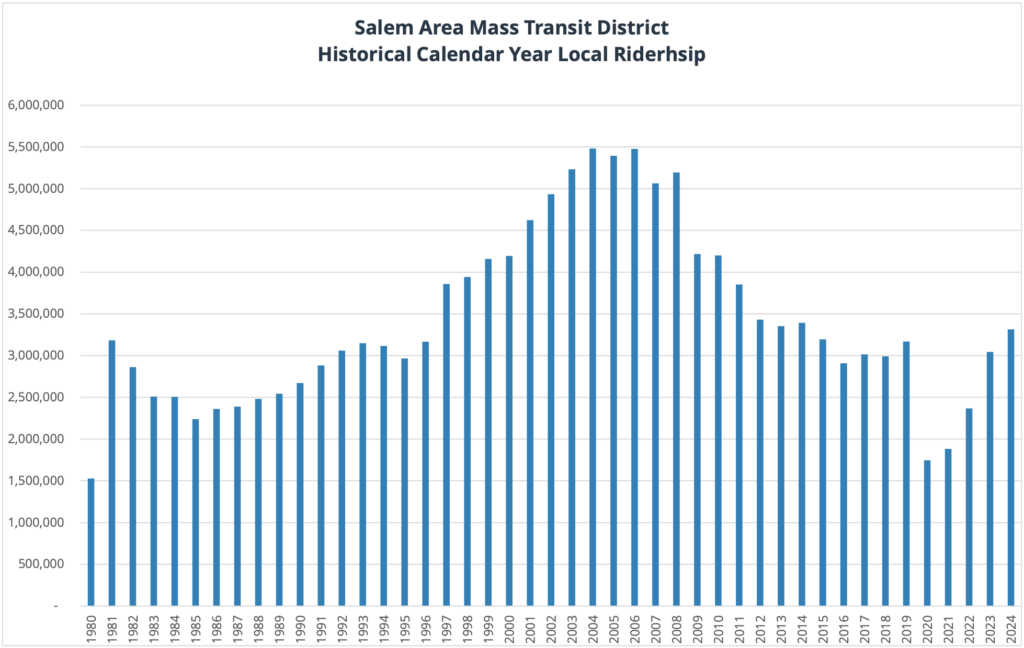
Although ridership has increased in the last few years, it hasn’t surpassed previous ridership levels from before the Covid pandemic.
The services Cherriots plans to fund with the tax have been picked out of feedback from existing riders through surveys and other communication with the agency. The tax would make transportation better for current riders, while making Cherriots more appealing to those who don’t use their transit options, Cherriots officials said.
Some people may not think about using Cherriots because there’s not a route in their area or the bus doesn’t come often enough, General Manager Allan Pollock said. Both of those limitations are items Cherriots leaders hope to address with the tax.
Annually, Cherriots local buses provided 3.2 million rides in 2024. That’s about the same number as in 2014. Ridership fell in the late 2010s, dropped significantly due to the pandemic in 2020 and has been increasing since. It remains below a peak of about 5.5 million rides a year in 2004.
Cherriots measures its ridership based on how many riders there are per hour of bus service, according to Pollock. The agency currently has an average of 15 riders per hour of service, or revenue hour, with many more people riding during the day and few at night, he said.
Cherriots operates on an annual budget of $155 million that comes from a mix of federal money, state taxes and local property taxes.
Fares made up about 5% of the agency’s operating revenue last year – about $2.7 million. That’s a lower share than the TriMet system in Portland, which gets about 8% of operating revenue from fares, or the Lane Transit District in Eugene, which gets about 6% of operating revenue from fares.
The largest share of the agency’s budget, about $71 million per year, is for operating buses and includes wages for drivers, fuel and security. Another $31 million funds management, information technology, finance and human resources.
Operations spending has nearly doubled over the past three years, which Pollock attributed to both rising wage and fuel costs and recent service expansions to add weekend hours.
The rest of the budget is savings, which is used mainly for one-time purchases and cash flow to ensure steady funding from July through November, when Cherriots brings in revenue from property taxes.
“What you can’t use it for is for service. So if we took $2 million and added service, well, when that money goes away, then how do you pay for the service? So you can’t really use the reserves for ongoing expenses,” Pollock said.
The transit district examines its fare prices every other year and will look at them again this year.
A full fare for a single ride is $1.60, and eligible people can pay a reduced fare of 80 cents.
Cherriots last raised fares in 2014.
Fare increases initially cause a small drop in ridership, but those normally recover within six months, according to Pollock. Some people stop riding the bus because the increase makes it too expensive to use the transportation, but people often return since the bus is a better option for them, he said.
“A quarter does not seem a lot to some people, but for some it’s pretty impactful,” Pollock said.
Cherriots leaders haven’t seen a reason to raise fares over the last seven years, with a 2018 bill helping fund Cherriots and then an influx of federal funding during the Covid pandemic.
Pollock said he sees a service expansion as a way to help people by providing a better transit system for the community as the cost of owning and driving a car becomes more expensive.
In the face of economic challenges, Pollock believes it’s important to provide better service for those who rely on it.
“It’s kind of the inverse, where we want to make sure that there’s good transit when times are tough, so that people have a viable option,” Pollock said. “But with the payroll tax, we’re not going to see any of that revenue for another year and a half. We don’t know what it’s going to be like in a year and a half, hopefully it’ll be better but we got to take action now for activity that’s going to happen in the future.”
Cherriots has an annual financial audit and posts that document, budgets and other reports on its website here.
PREVIOUS COVERAGE:
How Cherriots got its plan to expand services with proposed payroll tax
Cherriots board will delay new payroll tax a year as Chamber, others oppose effort
Cherriots plans for business tax to increase bus service, build transit stations
Contact reporter Madeleine Moore: [email protected]. Contact reporter Rachel Alexander: [email protected] or 503-575-1241.
A MOMENT MORE, PLEASE– If you found this story useful, consider subscribing to Salem Reporter if you don’t already. Work such as this, done by local professionals, depends on community support from subscribers. Please take a moment and sign up now – easy and secure: SUBSCRIBE.

Madeleine Moore joined Salem Reporter in 2024 and reports on a variety of topics including public safety, addiction, treatment and the criminal justice system. She came to Salem after graduating from the University of Oregon in June 2024 with a bachelor’s degree in journalism.