How Cherriots got its plan to expand services with proposed payroll tax

Leaders of Salem’s transit agency for years crafted plans to expand local bus service as the region’s population grew, even as bus ridership is about flat from a decade ago.
Those efforts drove the Salem Area Mass Transit District’s board to consider imposing a tax on businesses which has drawn significant pushback from business groups, the Keizer City Council and others.
Cherriots can impose a tax without a public vote under a state law passed in 2018 with Salem Area Chamber of Commerce backing. But after more recently seeking legal counsel, agency leaders said the tax could go to the public for a vote. The board considered that idea in August and is expected to discuss in November whether to put the tax on the ballot.
Board member Sara Duncan said she “deeply believe(s) in democracy” but noted that many people who rely on Cherriots service, including homeless people, refugees and teens, can’t vote or face significant barriers to doing so. She said her concern is that their voices wouldn’t be reflected in a public vote on the tax, though she said she would wait until open houses were done to decide on a path forward.
“To me, the voice of the banker in the chamber of commerce meeting and the mom who’s a refugee on my bus have the exact same weight in my decision,” Duncan said.
Share your thoughts
Cherriots is hosting two open houses in the coming weeks, inviting people to provide feedback on the proposed payroll tax and service expansion.
Monday, Sept. 22: 4-7 p.m. at the Keizer Transit Center, located at 5680 Keizer Station Blvd.
Tuesday, Sept. 30: 2:30-5:30 p.m. at the Seymour Center, located at 3745 Portland Rd. N.E. #190.
An online survey is available for the public to provide their experiences with Cherriots and thoughts on potential service improvements.
Cherriots leaders initially planned for the tax to take effect next January, but during discussion at a recent work session, the board chose to delay it until 2027 following strong opposition from the business community.
The current Cherriots board includes Bill Holmstrom, a state employee; Ramiro Navarro Jr., owner of consulting and automotive businesses; Joaquín Lara Midkiff, who is a history fellow at Stanford University, according to his website; Sadie Carney, a land conservation state employee; Maria Hinojos Pressey, deputy director of farmworker union PCUN; Ian Davidson, who works for the Oregon Department of Transportation on pedestrian and bicycle programs; and Duncan, recycling coordinator for Mid-Valley Garbage and Recycling Association.
The original plan would have imposed a 0.7% tax on employer payrolls that Cherriots estimated would raise $39 million in its first year.
Cherriots’s current budget is $155 million. Agency documents show that its budget has more than doubled over the last 10 years due to what it cited as increasing labor and fuel costs and adding weekend service.
Cherriots leaders have said the proposed tax would fund services to make public transportation more appealing and accessible for people and increase future ridership.
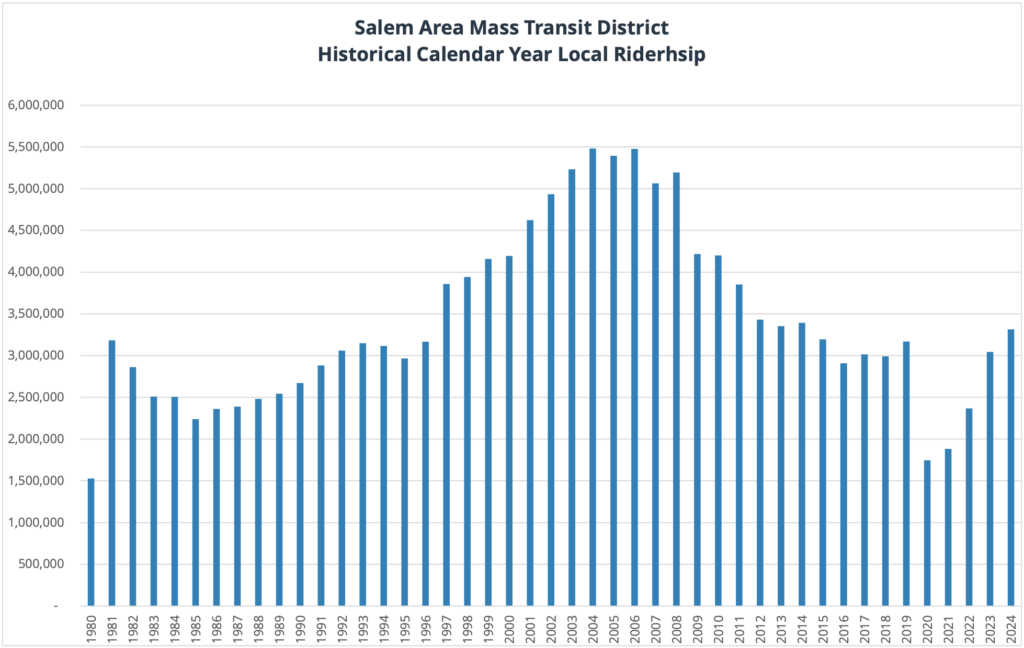
The expansion is expected to increase ridership by 3-4% per year, according to General Manager Allan Pollock. That increase would add around 96,000 more rides per year.
The enhancements also would address needs existing riders have expressed through surveys.
The transit agency had 3.2 million riders last year, the highest number since 2014 and roughly the same as pre-pandemic years after a sharp drop in 2020.
Pollock said the agency used details in regular reports and survey work to develop a plan to expand service. Those include Cherriots’ annual surveys of riders, long-term planning documents and interviews with local business leaders.
“What we wanted to do, and what we had done over the last year, is identify a service plan and then figure out the cost of that, and then the cost of the capital improvements needed, and then set a rate based on that, instead of just setting a rate,” Pollock said.
The services the tax would fund are intended to make the transit system more reliable and usable for people who take the bus outside of standard commuting hours.
That’s based on a survey that found riders want increased weekend service in south and northeast Salem, more frequent buses and expanded service hours.
Twelve local Cherriots routes run on either 15- or 30-minute schedules, split evenly between the two, according to the agency’s website. Another eight local routes run every 60 minutes.
The plan would increase the frequency of the agency’s local routes, but Cherriots leaders have not identified which routes could see increases in frequency.
Most routes run on weekends, with some only operating on Saturday.
In a 2024 assessment, the agency noted that the region was seeing more major employers requiring weekend and evening or early morning work.
“The current levels of weekend service at Cherriots were implemented as a backbone to build off of, providing the most basic level of service that functions as more of a life line than a fully-fledged transit system,” the assessment said.
What the tax would fund
Money from the tax would first go to improving existing services, Pollock told chamber members in July. Over the tax’s first five years, bus frequency, shelter safety and synchronized traffic lights would be some of the first services to get funded.
Most of the money would go toward added hours on weekends and holidays, early morning and late night service, according to numbers from Denise LaRue, Cherriots’ chief financial officer.
Major pieces include:
- Weekend and holiday service: $7.8 million per year
- Early morning and late night weekday service: $2.5 million per year
- More frequent weekday buses: $17.5 million to buy new buses, then $9.7 million for the first year of operation
- Micro transit pilot project, providing on-demand, smaller transit options: $2.4 million
- New loop route in downtown: $2 million in first year to buy new buses, $1.2 million in first year of operation
- South and east Salem transit centers: $3.8 million in the first year
The first phase, which will be in the tax’s first five years, would require around 50 employees to drive buses, 11 new buses and maintenance personnel to provide the expanded service, Pollock said in an email. The hiring process for transit operators will follow board decisions on what services will be initiated first.
The second part of the expansion, which will start around six years into the tax, will focus on creating new services at Cherriots and returning some previous ones, according to Pollock.
The tax would fund more micro transit, or individual vehicles for riders to take, improvements to Cherriots’ core downtown Salem route and bringing back special service for events like the Oregon State Fair and the Salem Art Fair, according to Pollock. That would cost about $45,000 per year.
PREVIOUS COVERAGE:
Your questions about Cherriots’ tax proposal, answered
Cherriots board will delay new payroll tax a year as Chamber, others oppose effort
Cherriots plans for business tax to increase bus service, build transit stations
Contact reporter Madeleine Moore: [email protected]. Contact reporter Rachel Alexander: [email protected] or 503-575-1241.
A MOMENT MORE, PLEASE– If you found this story useful, consider subscribing to Salem Reporter if you don’t already. Work such as this, done by local professionals, depends on community support from subscribers. Please take a moment and sign up now – easy and secure: SUBSCRIBE.

Madeleine Moore joined Salem Reporter in 2024 and reports on a variety of topics including public safety, addiction, treatment and the criminal justice system. She came to Salem after graduating from the University of Oregon in June 2024 with a bachelor’s degree in journalism.